Prophecies of Otranto
The Castle of OtrantoProphecies of Otranto bind the castle’s political crisis to a supernatural account of succession. What begins as a puzzling prediction that Otranto will pass from its ruling family becomes more specific through a giant sabre’s inscription, an omen at Alfonso’s statue, and Manfred’s final confession. The prophecies do not merely foretell change: they expose the concealed history that makes the dynasty’s claim to rule unlawful, while directing the story toward the rightful heir.
The Castle Prophecy and Manfred’s Marriage Plans
The first prophecy says that the castle and lordship of Otranto will pass from the present family when its rightful owner has grown too large to inhabit the castle. Its meaning is initially unclear, and the people of Otranto cannot see how it relates to Manfred’s urgent plan to marry his son Conrad to Isabella. Nevertheless, they interpret the haste as evidence that Manfred fears the prophecy’s fulfilment. The uncertainty is essential to its early force: it gives the wedding political urgency without yet explaining what the words mean or who the rightful owner might be.
The wedding is set for Conrad’s birthday, but Conrad’s death before the ceremony turns the question of succession into an immediate crisis. The prophecy’s language about the castle passing from the ruling family acquires a pointed context in the loss of Manfred’s only son, though its full meaning remains unrevealed. Manfred’s efforts to secure an heir through marriage thus unfold under a prediction that threatens the very continuity he is trying to protect.
The Sabre’s Inscription
A second prophecy is discovered through Frederic’s account of a supernatural disclosure. After wandering for three days in the forest, Frederic and his attendants find a dying hermit in a cell. The hermit says that Saint Nicholas had appeared to him more than fifty years earlier and instructed him to reveal a secret only at the point of death. He directs the visitors to dig beneath the seventh tree to the left of the cave. At a depth of about six feet, they find an enormous sabre, later displayed in the castle courtyard.
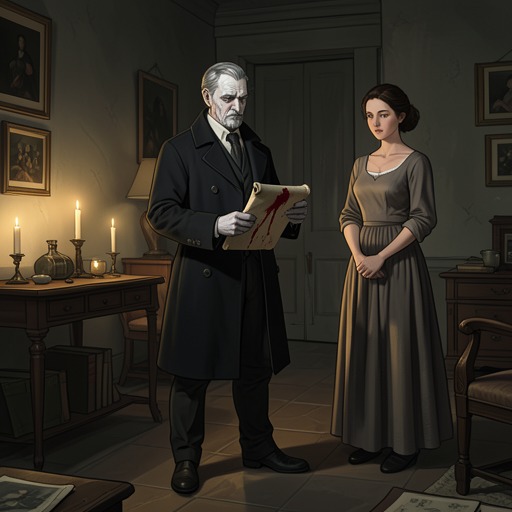
The sabre’s inscription connects a helmet, danger to Frederic’s daughter Isabella, Alfonso’s blood, and the repose of a restless prince. Frederic initially hesitates to recite it in the presence of Hippolita and Matilda, fearing that its words will distress them. Hippolita nevertheless asks him to continue, accepting that heaven’s decree must be heard with submission. Her reaction makes the prophecy more than a clue about future events: it is a threat to her family, particularly to Matilda, whose fate Hippolita fears even before the inscription’s conditions are fulfilled.
The inscription says that wherever a helmet fitting the sabre is found, the daughter is surrounded by peril; that only Alfonso’s blood can save her; and that this can quiet a long-restless prince’s shade. It joins physical objects and hereditary identity in a single prediction. The helmet points toward a material sign, while Alfonso’s blood makes descent, rather than political possession or marriage arrangements alone, the means of resolving the danger. Its reference to a restless shade also anticipates the supernatural judgment that will accompany the exposure of the family’s past.
Omens and Rival Claims
The prophecies operate alongside explicit disputes over who has the right to rule. A herald speaking for Frederic accuses Manfred of usurping Otranto from Alfonso the Good’s nearest blood relative, and demands both Isabella’s return and Manfred’s resignation. Manfred answers with a competing account: he says that Alfonso died childless in the Holy Land and left his estates to Ricardo, Manfred’s grandfather, in recognition of Ricardo’s service. He invokes inheritance through his father and grandfather, Ricardo’s military strength, and the favour of Saint Nicholas. The conflict therefore pits a claim based on an alleged bequest and generations of rule against a claim of nearer blood.
Manfred’s own account gives that disagreement a supernatural counterweight. When he says that Frederic has accepted Matilda’s hand and agreed to waive his claim unless Manfred has no male issue, three drops of blood fall from Alfonso’s statue. Jerome identifies this sign as proof that Alfonso’s blood will never mix with Manfred’s. The omen directly challenges the political compromise Manfred has announced: marriage cannot reconcile the houses if the supernatural sign declares their bloodlines incompatible.
A brief exchange involving Bianca reveals Manfred’s attention to Theodore’s resemblance to Alfonso. Bianca says that Theodore is the very image of Alfonso, as Matilda has remarked; Manfred becomes agitated and asks when Isabella first met Theodore, then denies that Isabella was whom he meant. The episode does not itself establish Theodore’s ancestry, but it brings the likeness into the chain of clues. The sabre’s emphasis on Alfonso’s blood and the statue’s rejection of a union with Manfred’s line give that resemblance dynastic importance before the final revelation explains it.
Fulfilment and the Hidden Lineage
At the end, Manfred confesses that Alfonso did not die a natural death: Ricardo poisoned him, and a fictitious will made Ricardo his heir. This disclosure overturns the version of succession Manfred had offered to Frederic. Ricardo’s descendants possessed and ruled Otranto, but that long possession rests on the concealed crime of killing Alfonso and falsifying the basis of inheritance. Manfred understands the disasters of the preceding days as the price of that usurpation, and concedes that he cannot explain how Theodore is Alfonso’s heir even as he accepts that the dominions belong to him.
Jerome supplies the lineage that resolves the apparent gap. During a storm on his voyage to the Holy Land, Alfonso was driven to Sicily, where he remained wind-bound for three months. There he married Victoria, but concealed the marriage because he intended to acknowledge her as his lawful wife only after returning from the Crusade. Alfonso left Victoria pregnant; she gave birth to a daughter while he was away, and news then reached her that he had died and Ricardo had succeeded him. That daughter later married Jerome, making Theodore the descendant whose connection to Alfonso fulfills the sabre’s reference to Alfonso’s blood.
The complete explanation joins the prophecies’ apparently separate strands. The castle prediction anticipates the end of Ricardo’s line; the sabre’s inscription identifies Alfonso’s blood as the key to resolving danger; and the bleeding statue rejects Manfred’s attempt to arrange succession by marrying Matilda to Frederic. The disclosures turn these signs into a judgment on both the origin and continuation of Manfred’s rule. His confession acknowledges that his family’s claim began in Ricardo’s crime, while Theodore’s revealed descent supplies the legitimate succession the signs have pointed toward.
Political and Narrative Significance
The prophecies make hereditary legitimacy visible through signs that unsettle the court’s human arguments. Manfred appeals to descent from Ricardo, a supposed bequest, and established possession; Frederic’s herald appeals to nearer blood; the sabre and statue introduce supernatural evidence that neither claimant can control. The eventual account confirms that bloodline matters, but it also reveals that a publicly accepted inheritance can conceal a murder and a false will. Succession is therefore not resolved by ancestry in the abstract: the narrative requires the buried truth about Alfonso’s marriage and Ricardo’s crime.
The predictions also change in meaning as their evidence accumulates. The first prophecy is reported as popular belief and appears difficult to connect to Manfred’s marriage plans. The sabre’s inscription gives the mystery a more concrete shape, tying danger to a helmet and deliverance to Alfonso’s descendants. The statue’s blood then challenges Manfred at the moment he claims to have secured a dynastic settlement. Finally, the deathbed confession and Jerome’s history explain the inheritance and make the earlier signs legible together. Their progression moves from ambiguous warning to public omen to family history disclosed, with each stage narrowing the distance between supernatural prediction and political fact.
At the conclusion, Manfred signs his abdication with Hippolita’s approval, and the couple enter neighbouring convents. Frederic offers Isabella to Theodore, but Theodore’s grief for Matilda prevents an immediate new attachment; only after frequent conversations with Isabella about Matilda does he accept that he can find happiness in Isabella’s company while continuing to mourn. The final outcome thus fulfills the transfer of Otranto without erasing the personal losses that accompany it. The prophecy’s resolution restores the rightful line, but its human cost remains part of the ending.